Auto-Generated Chronologies and Issue Charts: How AI Builds Your Case Timeline in Minutes
The Manual Timeline Problem
Every litigator knows the chronology. That sprawling, painstakingly assembled document that maps every relevant event, communication, and filing across the life of a case. In complex litigation, building the chronology is one of the most time-consuming tasks assigned to associates — reading through thousands of documents, extracting dates and events, organizing them sequentially, cross-referencing sources, and maintaining the document as new evidence emerges throughout the case.
A comprehensive chronology for a moderately complex commercial dispute might take 40-80 associate hours to build from scratch. For complex cases involving years of transactions and hundreds of custodians, that number can easily exceed 200 hours. And the chronology is never finished — every new deposition, document production, and filing adds events that need to be integrated into the existing timeline.
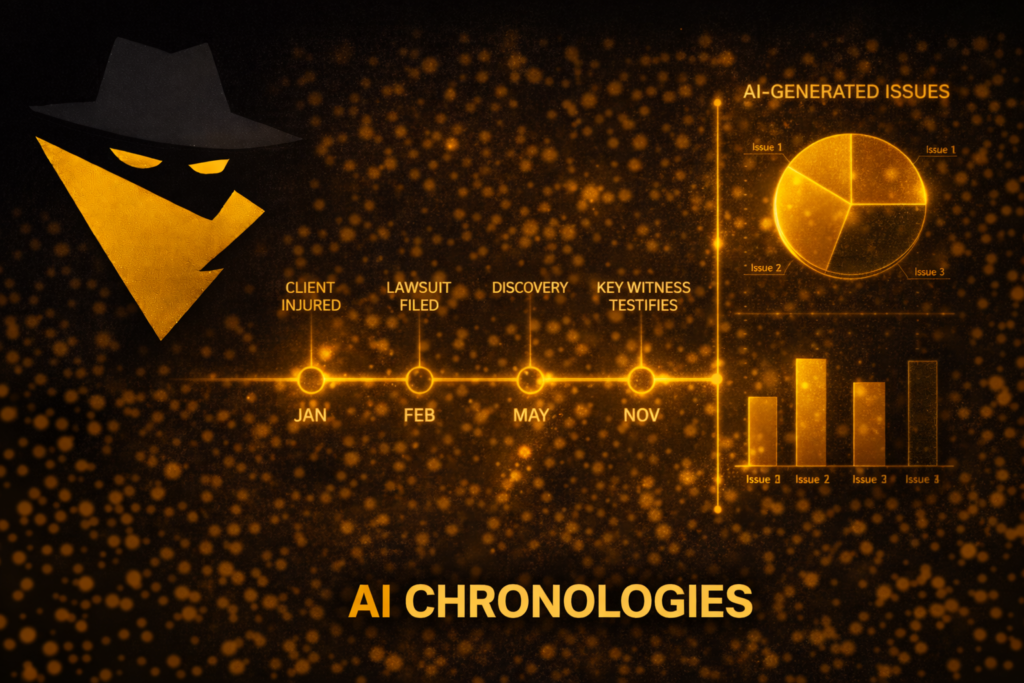
AI is collapsing this process from weeks to hours. Modern AI tools can process a full document set, extract every dated event, organize them chronologically, tag them by issue and participant, and generate a navigable timeline with source citations — all without a human reading a single document. The attorney’s role shifts from data entry to data validation and strategic analysis.
How AI Chronology Generation Works
Document Processing and Event Extraction
AI chronology tools begin by processing the case document set — emails, contracts, internal memos, court filings, deposition transcripts, and any other dated documents. The AI identifies every discrete event referenced in these documents: meetings, phone calls, emails sent and received, contract executions, regulatory filings, personnel decisions, financial transactions, and any other time-stamped occurrence.
The extraction goes beyond simply finding dates. The AI understands the significance of events in their legal context. An email from the CEO to the CFO discussing “adjusting the Q3 numbers” gets flagged differently than a routine scheduling email, even though both contain dates and participants. The AI categorizes events by type, assigns relevance scores based on the issues in the case, and identifies relationships between events that might not be apparent from reading documents individually.
This contextual understanding is what distinguishes AI chronology generation from simple date extraction. A basic search for dates in documents produces a list. AI produces a narrative timeline that shows not just what happened, but the connections between events and their potential significance to the claims and defenses at issue.
Issue Tagging and Cross-Referencing
Once events are extracted, the AI tags each event to the legal issues it relates to. In a breach of contract case, events might be tagged to contract formation, performance obligations, breach events, notice requirements, damages accrual, and mitigation efforts. In an employment discrimination case, tags might include hiring decision, performance evaluations, complaints filed, investigation events, adverse action, and comparator treatment.
This issue tagging enables filtered views of the chronology — an attorney preparing a summary judgment motion on the statute of limitations can filter to see only events related to when the plaintiff knew or should have known about the claim. An attorney preparing for a damages deposition can filter to see only events related to the plaintiff’s economic losses and mitigation efforts.
Cross-referencing connects related events across different sources. When a meeting is referenced in an email, discussed in a deposition transcript, and memorialized in meeting minutes, the AI links all three references to a single chronology entry, giving the attorney a complete picture of the evidence supporting that event.
Multi-Source Integration
Real cases involve evidence from multiple sources that often tell different stories about the same events. AI chronology tools handle this by maintaining source attribution for every event, flagging discrepancies between sources (the plaintiff’s email says the meeting was Tuesday; the defendant’s calendar shows Wednesday), and presenting disputed facts with both versions visible so attorneys can assess which version is better supported.
This multi-source integration is particularly valuable for identifying credibility issues. When a witness’s deposition testimony about the timing of events contradicts the documentary evidence, the AI flags the inconsistency automatically — no associate needs to independently cross-reference the transcript against the documents to catch the discrepancy.
Issue Charts: From Timeline to Strategy
What Are AI-Generated Issue Charts
While chronologies organize evidence by time, issue charts organize evidence by legal element. An AI-generated issue chart presents each claim or defense, breaks it into its required elements, and maps the available evidence — favorable and unfavorable — to each element. The result is a visual representation of where the case is strong, where it’s weak, and where additional evidence development is needed.
AI issue charts go beyond simple categorization. For each element, the chart identifies the best available evidence (the document or testimony most strongly supporting the element), the most damaging contrary evidence (the strongest argument the opponent can make on this element), the evidence gap (elements where available evidence is thin or ambiguous), and the recommended next steps (discovery targets, motion practice, or expert testimony needed to strengthen the element).
Dynamic Updates
One of the most powerful features of AI-generated chronologies and issue charts is their ability to update dynamically as new evidence enters the case. When a new deposition transcript is processed, the AI automatically extracts events and testimony, integrates them into the existing chronology, updates issue chart entries affected by the new testimony, and flags any contradictions between the new testimony and previously mapped evidence.
This dynamic updating means the litigation team’s strategic picture is always current. In traditional practice, chronologies and issue charts become stale between periodic manual updates, creating a gap between the team’s documented understanding of the case and the actual evidence record. AI eliminates this gap by maintaining the analytical framework in real time.
Practical Implementation
Getting Started with AI Chronologies
Implementing AI chronology generation doesn’t require a complete technology overhaul. Most eDiscovery platforms (Everlaw, Relativity) include chronology generation features that work within the existing review workflow. Standalone timeline tools like TimelineJS and CaseFleet offer AI-enhanced chronology capabilities that integrate with multiple document sources. And general-purpose AI tools like CoCounsel and Harvey AI can generate chronologies from uploaded document sets without requiring a dedicated eDiscovery platform.
The best approach for most firms is to start with a single case — preferably one where you’ve already built a manual chronology — and compare the AI-generated output against your existing work. This comparison reveals the AI’s accuracy level, identifies categories of events the AI handles well and categories where it struggles, and provides a concrete quality benchmark for evaluating different platforms.
Quality Control Protocols
AI-generated chronologies require verification, particularly for events that will be cited in motions or used at trial. The verification protocol should focus on three areas: date accuracy (confirming that events are correctly dated), source attribution (confirming that cited sources actually support the event descriptions), and completeness (identifying significant events the AI may have missed).
The completeness check is the most important and the most difficult. AI chronology tools are excellent at extracting events that are explicitly stated in documents but can miss implied events — events referenced obliquely or that require inference from multiple documents. The reviewing attorney should compare the AI chronology against their own case knowledge to identify any gaps, using the AI output as a comprehensive starting point rather than a final product.
Using Chronologies for Case Strategy
The strategic value of AI-generated chronologies extends well beyond having a neat timeline to reference. Pattern analysis across the chronology reveals periods of high activity that often correspond to critical decision points in the case. Communication analysis shows who was talking to whom, and when, highlighting the key relationships and information flows. Gap analysis identifies periods where expected activity is absent — a suspicious silence in the document record that may indicate destroyed or withheld evidence.
These analytical layers transform the chronology from a reference document into a strategic tool. The attorney who can see the communication patterns, the activity clusters, and the documentary gaps has a fundamentally better understanding of the case than one working from a flat list of events.
Use Cases by Practice Area
Complex Commercial Litigation
Complex commercial cases with years of transactions, multiple parties, and overlapping agreements benefit enormously from AI chronologies. The AI’s ability to process thousands of documents and map their temporal relationships reveals the story of the business dispute in a way that sequential document reading often obscures. Attorneys report that AI-generated timelines frequently surface connections between events that they hadn’t identified through manual review.
Employment Litigation
Employment cases revolve around temporal patterns — the sequence of performance evaluations, complaints, investigations, and adverse actions tells the story the jury will hear. AI chronologies that map these events with precision and flag temporal patterns (a complaint filed three days before a termination decision) provide the factual foundation for disparate treatment and retaliation claims.
Personal Injury
Personal injury chronologies map the incident, the medical treatment, the recovery progression, and the damages calculation. AI can process medical records, billing statements, employment records, and correspondence to build a comprehensive timeline that supports demand letters, mediation statements, and trial presentation. The treatment gap analysis — identifying periods where treatment was interrupted — is particularly valuable for anticipating defense arguments about causation and damages.
Regulatory and Government Investigations
Regulatory investigations often span years and involve massive document volumes. AI chronologies help investigation teams understand the timeline of events under scrutiny, identify the documents most likely to be requested by regulators, and prepare the company’s narrative in a way that’s consistent with the documentary record.
The Competitive Advantage of Speed
In litigation, understanding the case faster than your opponent is a significant strategic advantage. The firm that has a comprehensive, issue-tagged chronology within days of receiving initial document productions is making informed strategic decisions while the opponent is still reading documents. That speed advantage compounds throughout the case — earlier and better-informed discovery requests, more targeted depositions, stronger motion practice, and ultimately better outcomes for clients.
AI chronology and issue chart generation is one of the most accessible AI capabilities for litigation practices — the barrier to entry is low, the learning curve is gentle, and the ROI is immediate and measurable. For firms that haven’t yet integrated AI into their litigation workflow, this is an ideal starting point.
At Lawless Clicks, we help litigation firms market the capabilities that win clients. If your firm is leveraging AI to deliver faster, smarter litigation support, let us help you communicate that advantage to your market.
Frequently Asked Questions
How is AI transforming the legal industry?
AI is transforming law firms through automated document review, predictive case analytics, smart client intake systems, AI-powered legal research, automated billing, and intelligent marketing that identifies promising leads.
What are the risks of using AI in a law firm?
Key risks include potential ethical violations from unsupervised AI outputs, data privacy concerns with client information, over-reliance on AI for legal analysis, and the need to verify AI-generated content for accuracy.
How can small law firms afford AI tools?
Many AI tools for law firms offer tiered pricing starting at $50-200/month. Start with high-impact tools like AI chatbots for intake, automated email sequences, and content assistance. Scale up as ROI is demonstrated.
Looking for proven Law Firm SEO strategies that deliver real results? Lawless Clicks is a Law Firm SEO agency built for attorneys who want more clients from Google. Visit our homepage to learn how we can help your firm grow.


